
Kyocera will acquire 100 percent of the French company Nixka, which develops inkjet print engines, and will now be known as Kyocera Nixka effective from 1 April 2023.
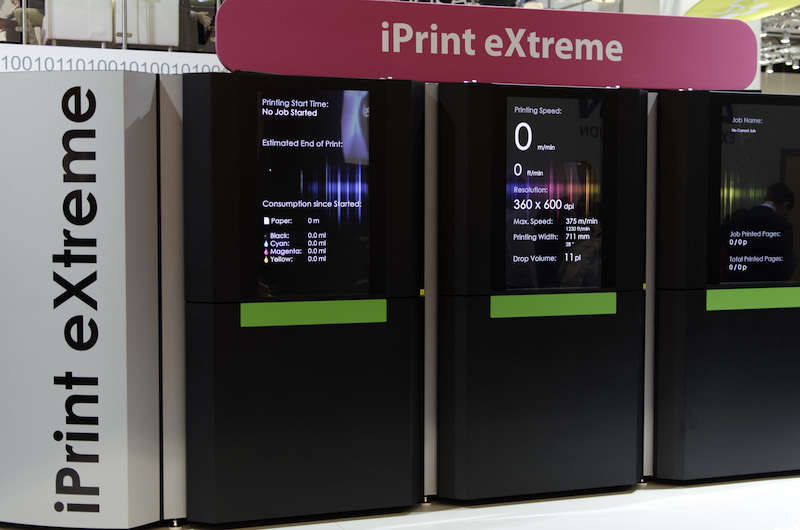
Nixka was set up in 2020 out of the ashes of what was once Impika before Xerox bought it back in 2013. Impika has been established in 2003 and most of the core team, including managing director Paul Morgavi, had come from GemPlus, where they had developed techniques for printing to plastic for things such as credit cards and smart passes. The company showed a number of highly innovative and very colourful single pass inkjet printers, such as the iPrint Extreme (pictured above), which combined high resolution and high productivity.
But Impika never seemed to match its early promise after being taken over by Xerox. It did produce the Rialto, a roll to sheet printer that had been shown as a concept before the Xerox acquisition. For Drupa 2016 the company introduced the sheetfed Brenva and the rollfed Trivor, and the following year announced a High Fusion inkset to allow the Trivor to print to offset papers.
Then in 2019 Xerox shut down the site in Aubagne, France, cutting the Impika team adrift in order to concentrate its inkjet development in the US. At the time both Kyocera and EFI were named as being interested in acquiring the French assets but these negotiations fell through and Xerox closed down its operation in Aubagne. But quietly in the background, Morgavi set up Nixka, which has marketed itself largely as a continuation of Impika. Indeed, the new company seems to be based at the same site in Aubagne, near Marseilles and many of its 13 staff did previously work for Impika though of course Xerox will have kept all the intellectual property from Impika.
Nixka mostly develops bespoke inkjet solutions that can be integrated into manufacturing lines. Consequently the company is mostly offering market analysis and proof of concept, which is described as a differentiating advantage though is really the same as everyone else involved in industrial inkjet integration projects.
Besides this, Nixka has developed a print engine, called Fenix, which uses piezo heads with recirculation and can print at 400mpm. It’s a monochrome system and can be adapted with different printing widths, resolution and speeds. It can be integrated into existing equipment, including flexo, offset or gravure presses as well as finishing systems, packaging lines and manufacturing processes. The first of these was installed last year at a customer site for a company specialising in paper packaging with bases in Europe and North America.
Nixka also says that it is developing a high quality print system with resolution of 1200 and 2400 dpi for commercial print, photo printing and flexible film applications. Kyocera has said that Nixka uses its printheads though Nixka itself also lists Fujifilm Dimatix and Memjet as partners.
In addition, Nixka has won funding from the EU’s Horizon Europe research program as part of the Waste2BioComp project, which aims to transform organic waste into sustainable and bio-based components, such as sustainable inks, for packaging and textile applications.
Kyocera has said that it will use this acquisition to “expand its business into new markets, including print engines, systems and integrated services.” The Kyocera press release is full of wooly statements about “promoting the widespread use of inkjet printing technologies” but the logic behind this acquisition is spot on. The best way to advance industrial inkjet – and therefore to sell printheads – at this current moment is through bespoke integration projects that can demonstrate how inkjet can be used in manufacturing processes. So buying a company that specialises in this area makes perfect sense. It is after all the same logic behind Fujifilm’s acquisition last year of Unigraphica.
It’s also worth noting that Kyocera is expanding into the production printer space with its own inkjet machines. The company has had some success with the TaskAlfa 15000C and at last year’s IGAS show in Tokyo revealed its plans to develop this range further with a new printer next year able to print to coated papers. I expect that we will see Kyocera developing inkjet printers for other market sectors, and although this is run from a separate division – Kyocera Document Solutions – it’s likely that Nixka will also be able to help with this.
Nixka undoubtedly has a great deal of expertise in inkjet, with Morgavi and his colleagues having a proven track record with Impika. However, buying a foreign company is not the same as making a success of it, as Xerox discovered with Impika. Still, it will be interesting to see what Nixka can produce with Kyocera’s funding behind it.
You can find further information from nixka.fr and kyocera.com.
Leave a Reply