
Heidelberg has released its financial results for its third quarter, ending 31 December 2025, which show sales up year on year by 4 percent to €617 million, with incoming orders down slightly from €550 million to €517 million, which Heidelberg attributes to a natural slowdown after the Drupa orders.
The Earnings Before Interest, Tax, Depreciation and Amortisation for this quarter were €50 million, which appears to be a big jump from last year’s €26 million but the Q3 figures for 2024 include €29 million set aside for restructuring staff numbers, which does not feature in this year’s Q3. Heidelbrerg says that this restructuring led to an improvement in production and total functional costs.
The operating activities or Earnings Before Interest and Taxes figure was €31 million, up from €8 million in the previous year. That led to a net result after taxes of €17 million, a distinct improvement on the €7 million loss from last year’s Q3.
Looking at the different regions, Heidelberg saw a fall in orders in the EMEA region in general though orders and sales rose in Q3 due to a state-funded investment program in Italy. Sales fell across the Asia Pacific region, with a 16 percent fall in sales to the Chinese market. However, Heidelberg did see orders rising from the Americas by 17 percent and noted that “there is still uncertainty with respect to customs tariffs and how they will develop in the future.”
Heidelberg reorganised the structure of its various divisions since the start of April 2025 into three main parts. Thus the Print and Packaging Equipment, which includes offset, flexo and postpress solutions, saw its sales increase in this quarter from €310 million to €340 million, while the EBITDA remained at €36 million.
Then there is the Digital Solutions and Life cycle division, which consists of digital printing, software, services and consumables. Here the sales fell from €272 million to €263 million, with the EBITDA also falling from €23 million to €16 million. Heidelberg has attributed this to temporary affects from its product mix.
Dr. David Schmedding, Chief Technology & Sales Officer, says that Heidelberg’s strength lies in the combination of presses, software and servicing, noting: “By specifically expanding our digital printing portfolio and launching new high-performance systems such as the Jetfire 75, we are creating additional growth potential – both in our core business and beyond.”
The third segment, Heidelberg Technology, covers areas such as e-mobility and contract product development and manufacturing for third parties, including defence and industrial system solutions. Here the sales rose from €12 million to €14 million, though the EBITDA for this year’s Q3 was a loss of €3 million, a slight improvement on the 2024 Q3 loss of €4 million. Heidelberg says that it is planning to expand the defence side of this and making investments accordingly.
Jürgen Otto, CEO of Heidelberg, commented: “Both strategically and operationally speaking, Heidelberg is extremely well positioned to actively hone this plan and leverage additional opportunities in dynamic future markets.”
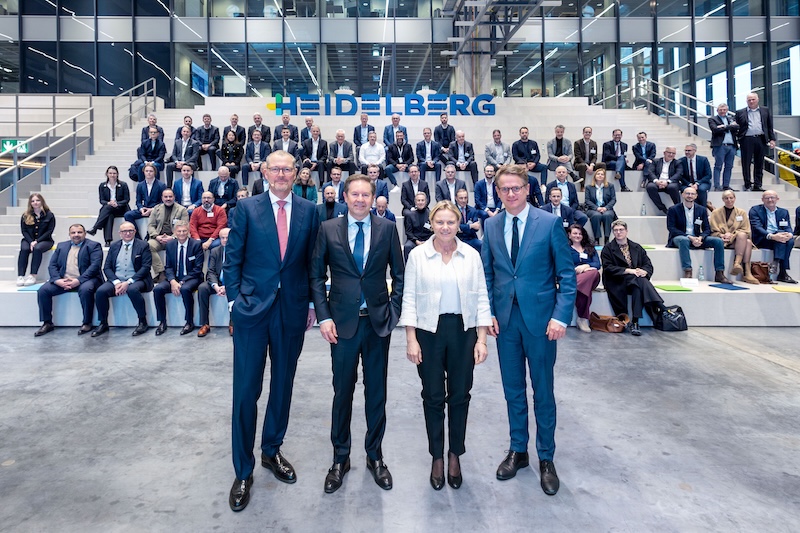
To underline this, Heidelberg recently hosted an ‘Economy in Dialogue’ event that brought together more than 70 decision-makers from the regional economy as well as several politicians, including Dr. Carsten Linnemann, Secretary General of the CDU, Christiane Staab, Member of the State Parliament of Baden-Württemberg (CDU) and also Dr. Rainer Dulger, President of the Confederation of German Employers’ Associations (BDA).
As Otto pointed out at this event: “The German economy is under considerable pressure. Compared with other countries, high labour costs and energy prices, complex regulations, and bureaucratic and lengthy decision-making processes are slowing down investment and innovation.” He added: “We are particularly confronted with these challenges at our largest site in Wiesloch-Walldorf. We have developed our strategy to address them.”
As part of this strategy, Heidelberg reorganised its group financing at the start of 2026, replacing the syndicated credit line from 2023 with a new syndicated loan, extended ahead of schedule to 2030 and increased from €370 milion to €436 million. This should give the company better financial flexibility for its planned business expansion. However, it’s worth noting that Heidelberg only used €91 million of this previous credit line, mainly for cash drawdowns and guarantees for export transactions.
Heidelberg believes that it is still on track to deliver on its full year forecast, expecting sales of around € 2,350 million, up from the previous year’s € 2,280 million. The full year’s results should be published around 10 June 2026. In the meantime, you can find further details from heidelberg.com.
Leave a Reply