
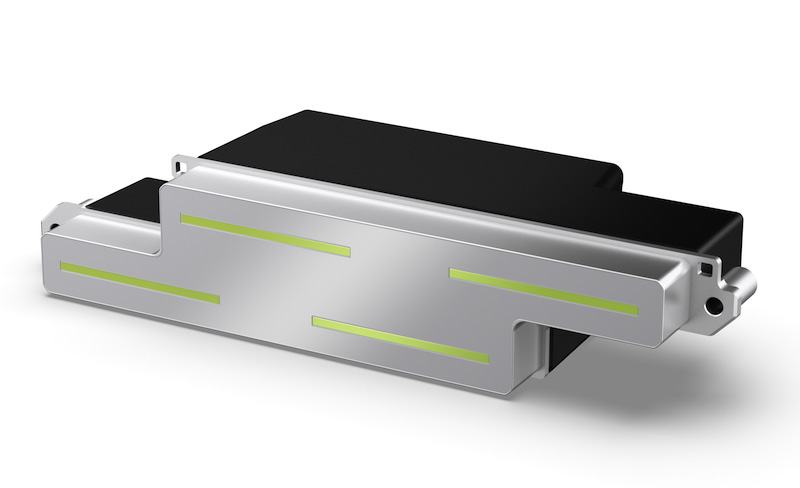
Epson has announced a new variant on its S3200 inkjet printhead, the S3200-S1, which has been developed to handle the type of strong solvents that are used in some manufacturing processes.
Essentially, Epson has changed some of the materials used in the printhead to those that can better withstand aggressive solvents, which can dissolve some plastics. Otherwise, this is a standard S3200 head using four of Epson’s PrecisionCore chips arranged in an S-shape that allows multiple heads to be slotted together for wider print widths. The resolution is 600 dpi assuming a single fluid, or 300 dpi for two channels.
The solvents in question include NMP, DMSO, DMF, and DMI, which are used in advanced applications such as the formation of multiple functional layers in perovskite solar cells. Most of these applications have been limited to R&D labs and short run production. But Paddy O’Hara, head of printhead sales for Epson Europe, says that as the R&D bears fruit so the production of these applications is ramping up, adding: “Making a product that is easily integrated into large arrays or complex machines is a logical step. So as the technology matures the market is demanding these kind of products.”
Up to now, Epson has offered the S800-S1 for these applications, which has a 1.33-inch print width. The new S3200-S1 offers a print width of 4.73 inches or 120.2mm, which will reduce the need to stitch multiple heads together, simplifying the configuration for the production devices.
O’Hara says that this head is mainly targeted at solar, semiconductor and similar applications, where the main production markets are likely to be in Korea and Taiwan even though much of the R&D is still based in Europe.
The South Korean firm Gosan Tech Co., Ltd. is currently testing the use of S800-S1 printheads in the mass production of perovskite solar cells. Kim Kwangsoo, President of Gosan Tech, commented: “We believe inkjet printing technology will play a central role in the commercialisation of perovskite solar cells. Epson’s PrecisionCore printheads offer excellent durability and stability against solvents and are optimized for uniform and precise thin-film deposition. We will continue to work closely with Epson to lead innovation in the solar cell industry through inkjet technology.”
Epson says that it expects the perovskite solar cell market to grow rapidly from 2025 onward, and that some forecasts suggest a global market size of approximately ¥2.4 trillion by 2040.
This follows a recent announcement from Konica Minolta of its KM1024i-SHE-HM-LV printhead, also targeting the same market. It’s also worth noting that Epson introduced other variants on the S3200 head earlier this year to improve their performance with UV-curable inks. You can find a broad description of the S3200 printhead and the way that Epson structures its PrecisionCore heads here.
The S3200-S1 printhead should be available in Q1 of 2026, although some early trials have been undertaken with some key OEMs in Asia. Readers can find further information on the PrecisionCore printheads from corporate.epson and on the range of printheads from epson.jp – which is in Japanese but with an English translation.
Leave a Reply