
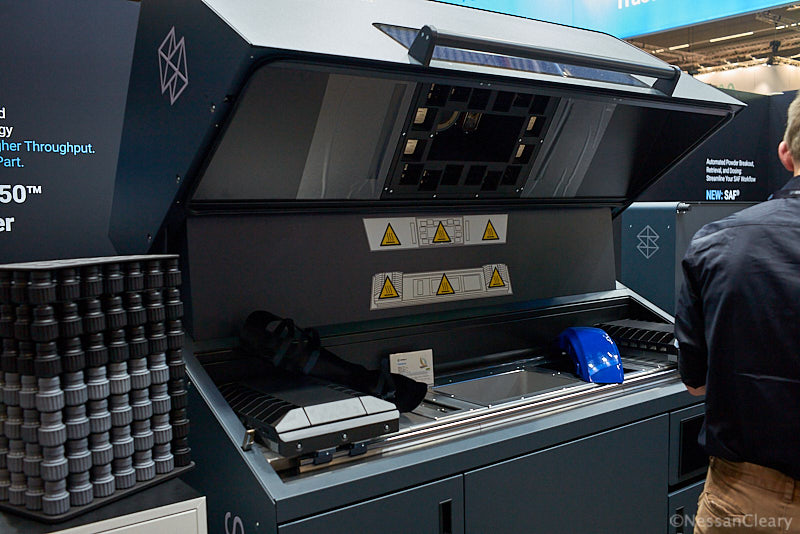
Stratasys has shown off a new industrial 3D printer, the H550, together with the PowderEase T2 post-processing system. These sit within Stratasys’ Selective Absorption Fusion portfolio of powder bed fusion printers.
It’s primarily designed to produce jigs and fixtures as well as production parts for different industries including medical and automotive, mainly using various PA12 materials as well as PA 11 and polyproylene.
Stratasys acquired the SAF technology from Xaar in 2021. It uses inkjet printheads to apply a fusing fluid on a powder bed. This is followed by an infrared lamp that uses heat to bind the particles together to form a layer. The process is then repeated layer by layer to build up the parts on the bed. Stratasys says that this method supports high-volume production of complex shapes in an efficient and cost-effective manner. This is based on production throughput, reuse of unused powders and the turnaround time between builds of around 30 minutes.
As such, this technology mainly competes against SLS selective laser sintering machines, with Stratasys claiming up to 30 percent lower total cost of ownership for the H550 compared with similar SLS devices. Rich Garrity, Chief Business Unit Officer for Stratasys, argues that whatever ssytem manufactuers choose will shape their production for many years: “Before committing to their next powder bed fusion investment, they should see what the H550 can do. It brings greater capacity, larger parts and more attractive production economics designed to scale, so more applications can move onto the factory floor.”
The H550 is an evolution of the existing H350 3D printer. For this latest machine, the build chamber has been expanded to 365 x 208 x 450mm, which is 80 percent bigger area than the existing H350 printer. The main advantage is that the build area is longer so that it can accommodate longer parts, as well as nesting more parts together. It can complete a full build in 16 hours, which Stratasys says is up to 50 percent higher throughput than the H350, despite it being quicker with a full build in 12 hours.
Neil Hopkinson, VP SAF at Stratasys and inventor of the technology behind SAF, said: “Longer parts than other print-and-fuse systems, faster than SLS, and at a lower total cost of ownership. With the H550, SAF is designed to give manufacturers a production system that provides the best available combination of part size, throughput and economics.”

Stratasys also showed off the PowderEase T2 automated powder handling system that has been designed to accompany the H550. This is essentially the same as the T1 that’s used with the H350 but with a larger capacity to cope with the bigger build volume of the H550. These devices automates breakout, powder retrieval, sieving and dosing. The T2 is designed to support up to six H550 systems from a single station when using the same material.
You can find further information from stratasys.com.
Leave a Reply